
Products
Yes. It is. NadPrep EZ RNA Library Preparation Kit is suitable to
most RNA samples from different grades and sources (cells, fresh tissues etc.).
For FFPE-derived RNA samples with severe fragmentation (DV200 <
20), reverse transcription efficiency may be reduced, and it is recommended to increase
the no. of PCR cycles as appropriate. When performed targeted capture on FFPE-derived
RNA samples, consider increasing the RNA input to improve capture efficiency.
NadPrep EZ RNA Library Preparation Kit is widely suitable for the libraries
prepared from total RNA with different grades, poly(A)-enriched mRNA, and rRNA-depleted
RNA. It should be noted that the mRNA content in total RNA from different
sources varies greatly. If the initial input amount of total RNA is too low, sufficient
mRNA may not be obtained to prepare a high-quality library.
RNA-Seq library preparation generally falls into two types:
non-stranded (general) and stranded (strand-specific). The core difference is
whether the library retains transcript directional information. Among them, stranded
libraries retain the transcript directional information during the preparing
process, and sequencing and downstream analysis can determine whether the
transcripts originate from the sense or antisense strands of DNA. However, non-stranded
libraries lose directional information during cDNA synthesis, and sequencing
data cannot directly indicate transcript directions. Compared with general
RNA-Seq, strand-specific RNA-Seq provides more accurate transcript
quantification, clearer gene structures, identification of antisense
transcripts, and discovery of novel transcripts. Therefore, stranded RNA-Seq is
crucial for studies of gene structure and expression regulation. To obtain
transcript direction information, stranded libraries should be preferred.
No. This kit is
compatible only with gDNA or cDNA as initial samples. For RNA samples, reverse
transcription to generate cDNA is required prior to library preparation.
This kit supports
50-2,000 ng of gDNA or cDNA. For input amount exceeds 2,000 ng, split the
sample into multiple reactions to maintain amplification efficiency.
The main peak of
PCR products by using this kit is ~270 bp. PE150 sequencing is recommended for
high-quality coverage.
A minimum of 0.3
Gb is recommended to detect clones at 0.01% abundance with an input of 200 ng.
Increase data volume to enhance sensitivity for low-frequency clones.
Yes. This kit
includes IG Primer Mix and TR Primer Mix with gene-specific primers provided in
separate tubes, allowing flexible combination in a single amplification
reaction. With its high sensitivity, the kit meets the requirements for MRD
monitoring technology development and clinical applications, making it ideal
for low-frequency variant detection scenarios.
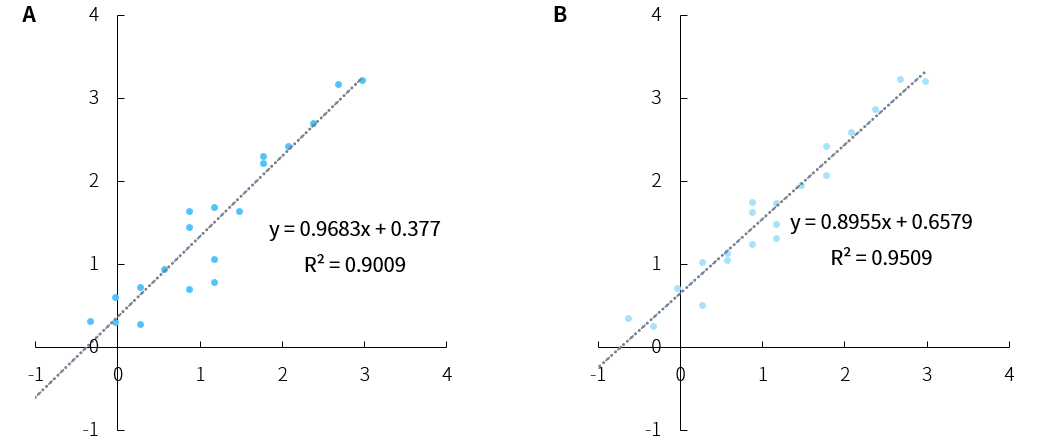
Figure 2. Correlation of ERCC expression profiles in captured libraries from RNA samples processed through different library preparation protocols. A. NadPrep RNA & DNA Library Co-Preparation Module; B. NadPrep Total RNA-To-DNA Module conjunction NadPrep DNA Library Preparation Module.
Note: The samples originated from K562 cell line RNA with an initial input of 50 ng; the pre-library input amount was 200 ng.
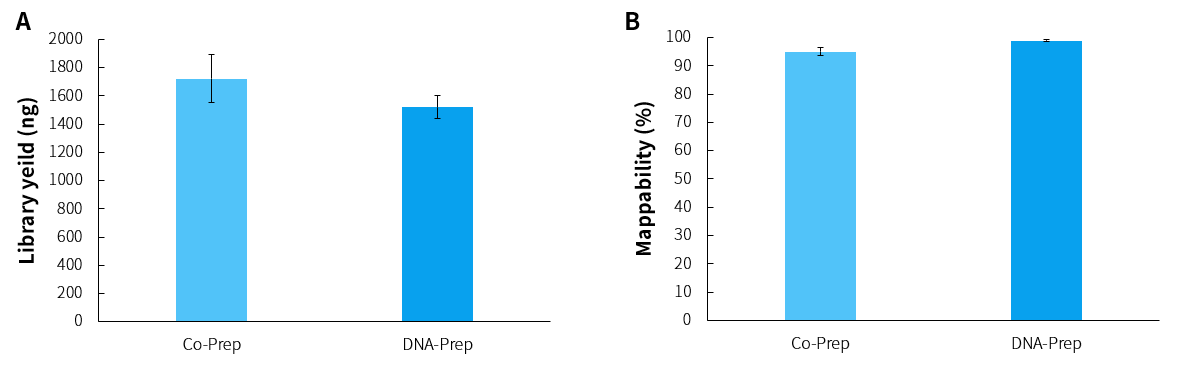
Figure 1. Library yield and capture performance of DNA samples using different library preparation protocols. A. Library Yield; B. Mappability.
Note: The sample originated from 50 ng of Human Genomic DNA Standard (Promega, G1521). Sequencing mode was Illumina NovaSeq 6000 platform, PE150.